I’ve heard the rent-versus-buy debate for most of my real estate career.
Depending on who is making the argument, renting is either the smarter financial decisio because it frees up money for investing, or homeownership is the single greatest wealth-building tool available to the average American.
The reality is that both sides make valid points.
Renters correctly point out that homeowners face property taxes, insurance, maintenance, repairs, and the opportunity cost of tying up a large down payment. Homeowners correctly point out that real estate appreciates, mortgages get paid down over time, and housing costs become increasingly predictable while rents continue to rise.
The problem is that most rent-versus-buy discussions focus on only one piece of the puzzle.
The better question isn’t whether renting or buying is universally better. It’s whether one is likely to leave the average person in a stronger financial position over time.
To explore that, let’s use a realistic Austin example.
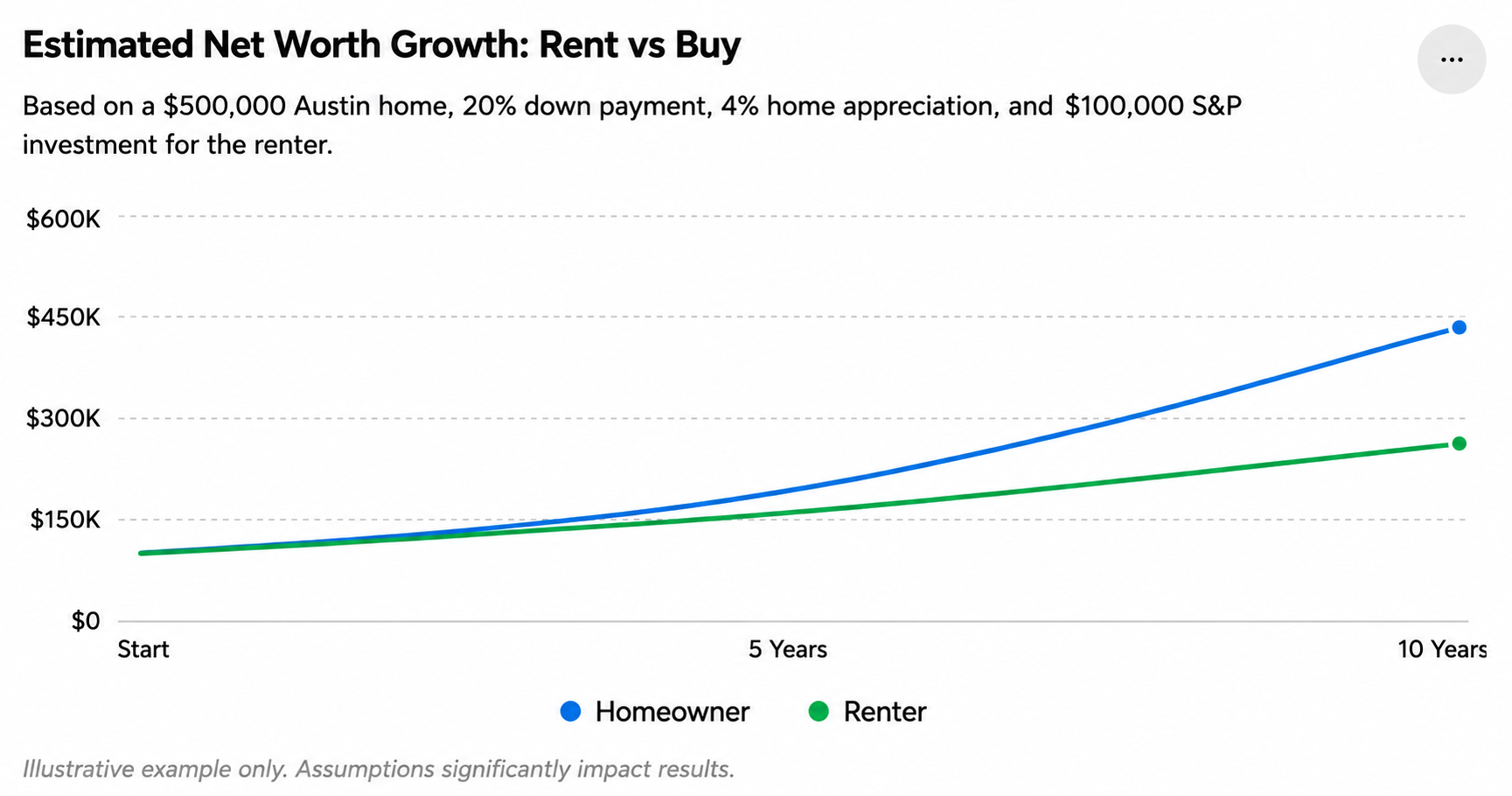
Assume a $500,000 home purchased with 20% down ($100,000), a 6.5% mortgage rate, property taxes of 1.8%, insurance of 0.45%, and a maintenance reserve equal to 1% of the home’s value annually. We’ll compare that to a similar home renting for approximately $3,350 per month with rents increasing 4% annually.
To make the comparison as fair as possible, we’ll also give renters every benefit of the doubt.
We’ll assume the entire $100,000 down payment is invested in the S&P 500, earns long-term average returns, and remains untouched for the entire analysis.
The Five-Year Comparison
Using 4% annual home appreciation and a 10% annual stock market return, the homeowner’s position after five years is surprisingly strong.
The $500,000 home grows to approximately $608,000 in value, creating more than $108,000 in appreciation. During that same period, mortgage payments reduce the loan balance by roughly another $23,000.
The homeowner now has approximately $231,000 in equity. Meanwhile, the renter’s $100,000 investment grows to roughly $161,000.Even after accounting for the homeowner’s higher monthly housing costs and maintenance reserve, the homeowner finishes the five-year period ahead by roughly $30,000. Not a landslide, but certainly not the outcome many people expect.
The Ten-Year Comparison