
There’s no denying it. Housing costs more than it used to.
In Austin, as in much of the country, home prices have risen substantially over the past several decades. Higher mortgage rates, increased construction costs, labor shortages, insurance premiums, land values, and inflation have all contributed to that reality.
But the conversation often ends there. What often gets overlooked is that we’re not simply paying more for housing today….we’re paying for something entirely different.
Because when people compare today’s housing prices to those of previous generations, they’re often comparing two completely different products. A typical home in the 1950s or 1960s was roughly 1,000 to 1,400 square feet. Many had a single bathroom. Some lacked central air conditioning. Storage was limited. Garages were smaller or nonexistent. Closets were tiny. Kitchens were functional, not showpieces. Yet those homes successfully housed larger families than we typically see today.
Fast forward to 2026.
The average new home is now more than 2,500 square feet. Multiple bathrooms are expected. Two and three-car garages are common. Walk-in closets, open floor plans, home offices, smart technology, security systems, energy-efficient features, outdoor living spaces, and premium finishes are increasingly viewed as standard rather than luxury. We’re comparing today’s housing prices to yesterday’s housing products, and they’re not remotely the same thing.
That’s not to suggest housing hasn’t become more expensive. It has. But part of what has become more expensive is our expectation of what a home should be. The same modest housing product used in many long-term affordability comparisons still exists.
You can drive from Austin to Taylor and find 1950s-era homes around 1,400 square feet. Some need updating. Some lack the amenities buyers now expect. Yet many remain available at prices that fit surprisingly well within the range one might expect when accounting for decades of inflation and income growth.
But there’s more than a home than a house. Buyers today often want larger homes, more amenities, modern systems….but convenient access to jobs, restaurants, entertainment, and recreation. At the same time, Austin is no longer the small, affordable city it once was. It has evolved into a major economic and cultural hub, attracting people and businesses from across the country.
The result is that we’re not simply comparing today’s housing prices to yesterday’s housing prices. We’re comparing today’s housing expectations to an entirely different housing product in an entirely different city.
Neighborhoods that were once considered the outskirts of town are now among the most desirable locations in Central Texas. Areas like Allandale were originally suburban developments serving a much smaller city. Today they sit near major employers, entertainment districts, restaurants, medical centers, universities, and cultural amenities that barely existed when those homes were built. The city grew up. And growing cities become more valuable.
That’s why Austin is better compared to places like Denver, Seattle, San Diego, Boston, and Los Angeles than it is to the Austin of 1975. Viewed through that lens, Austin remains remarkably affordable.
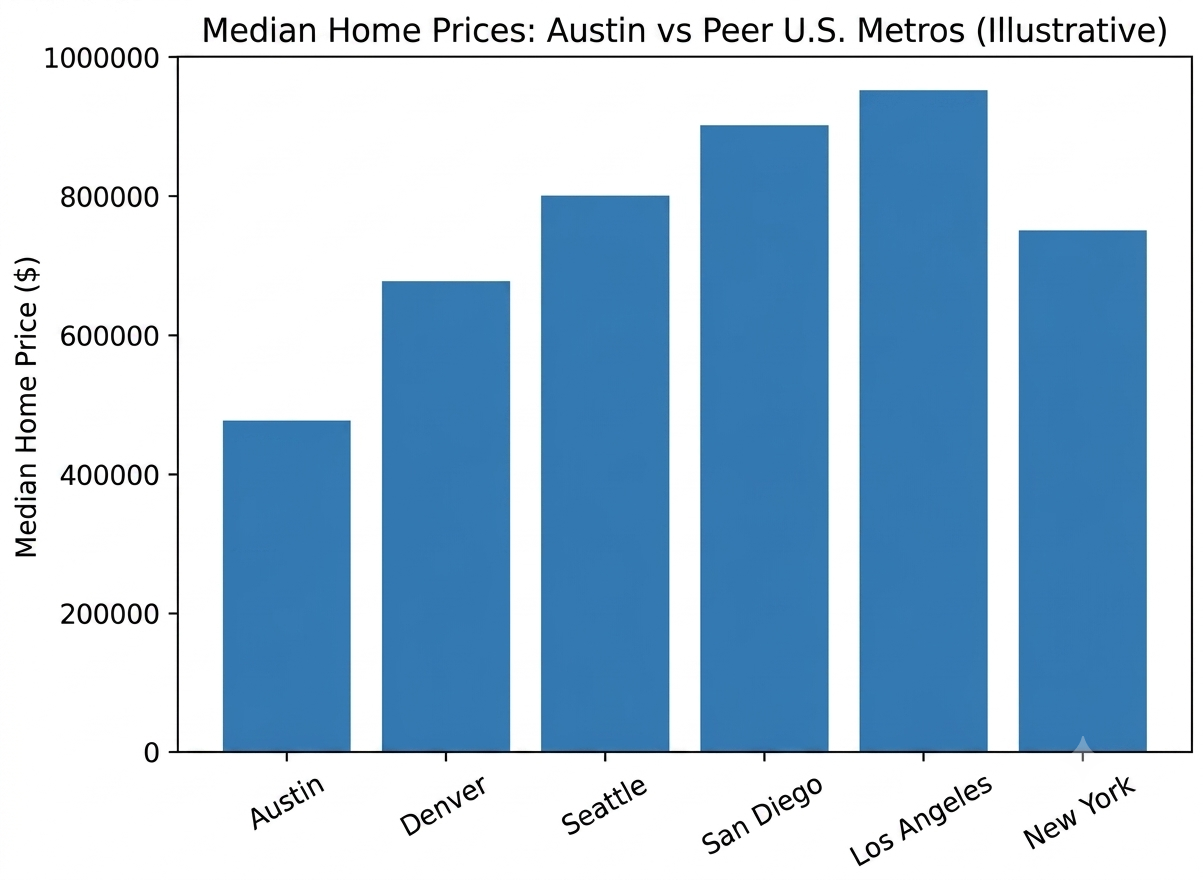
In other words, Austin may no longer be cheap. But compared to the cities it now competes with, it remains quite affordable.
The reality is that housing affordability is not a single story. Shelter has become more expensive. Austin has become more valuable. And consumer expectations have become more ambitious. All are true at the same time. Understanding that distinction doesn’t make housing cheaper. But it does provide a more complete picture of why prices are where they are today.
Perhaps the better question isn’t whether Austin housing has become unaffordable. Perhaps it’s whether our expectations have risen just as quickly as the city itself.